
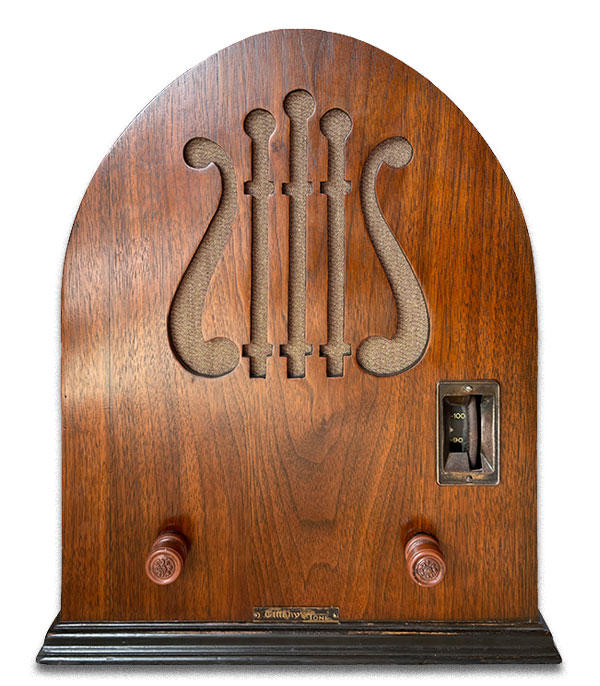
The Model 60 - Tiffany=Tone
This is a landmark radio in the Los Angeles radio manufacturing story.
It was first introduced in the Art Deco cabinet styling. The Jackson-Bell Model 60 chassis housed in a cathedral cabinet, was manufactured by Jackson Bell for Herbert Horn on the Gilfillan Bros assembly lines in June/July of 1930. Branded "Tiffany-Tone", this set was Herbert Horn's first radio and marked their entry into the radio "manufacturing" industry. Horn had previously been a radio distribution company.
This set saw the two companies' working together. It marked the beginning of a brief period of collaboration between them (approx. 3-4 months). This occurred prior to Herbert Horns' departure from Gilfillan Bros in August/September 1930 to commence his own radio manufacturing operations (Radio and Jobber Magazine, September 1930).
The Model 60 began a completely new strategic marketing focus and direction for Jackson Bell as they began to produce several Model 60 chassis radios. They were predominantly housed in the cathedral cabinet style, which were "House-Branded" for others. Taking the Horn-coined name (Tiffany-Tone) as a theme, Jackson Bell manufactured Model 60 sets badged "Trumpet-Tone" and "Mello-Tone". They also produced Model 60 "House Branded" sets for others (refer to the Waltham Model 60 and Loesers Department store offerings). This new marketing strategy was the precursor to that applied to the hugely successful Model 62.
A standard Jackson-Bell Model 60 schematic is attched to the back of the chassis.The tubes are the traditional model 60 tube compliment.
This catheral style lyre grille design was an import model found by Mark Thomson in Aukland, New Zealand, and added to his collection.
The Model 60:
The Model 60 Chassis was a success for Jackson Bell. It was produced in many cabinet variations under the Jackson-Bell brand, and in many house-branded sets. The set was distributed throughout the United States.
The success of the Model 59 was followed by the Model 60. There are many similarities between these two models. The most obvious difference is the addition of a second knob for regeneration to improve sensitivity and selectivity when necessary. This is an earlier technology that introduces another adjustment.
Jackson-Bell stressed the phrase "Screen Grid, of Course" in marketing Model 60s. The 24A tube is used as a detector, not as an R.F. amplifier.